

![M | Evolving Mixtape: DIY în comunitatea muzicală brașoveană [RO/EN]](https://litera9.com/wp-content/uploads/2026/09/EMT-1.jpg "M | Evolving Mixtape: DIY în comunitatea muzicală brașoveană [RO/EN]")
Am descoperit Evolving Mixtape în 2025, când am dat curs unei invitații venite de la o prietenă pentru o bere la Champions Sports Bar. Seara s-a simțit diferit, pentru că barul nu anunța nimic din ce avea să se întâmple. Atunci am aflat detalii despre Evolving Mixtape și cum se poate participa cu un playlist.
Nu credeam că voi face asta vreodată, dar după o a doua seară de Evolving Mixtape, m-am decis să particip cu un playlist personal, pe care l-am denumit Meowsic.
Aproximativ un an mai târziu de la realizarea acelui playlist și seara de Evolving Mixtape, am avut plăcerea să stau de vorbă cu David, Philip și Vlad despre Evolving Mixtape, cum a apărut ideea, cum funcționează și toată semnificația din jurul unui concept DIY (Do It Yourself).
Trăim într-o eră pe care sociologii contemporani o definesc tot mai des prin prisma unei „epidemii de singurătate”. Deși suntem interconectați prin mii de fire digitale invizibile, paradoxul este că izolarea noastră în bulele algoritmice nu a fost niciodată mai profundă. Ne hrănim cu sugestii automate, cu playlist-uri care ne confirmă prejudecățile muzicale și cu interacțiuni mediate de ecrane care sterilizează experiența umană. În acest peisaj de alienare urbană, o întrebare aparent banală capătă greutatea unui manifest: cum a reușit un bar de sporturi din Brașov să devină epicentrul unei mișcări de rezistență culturală, unde metalul extrem, jazz-ul de avangardă și muzica turcească se întâlnesc și construiesc, piesă cu piesă, ideea de comunitate?
Răspunsul se ascunde sub numele de Evolving Mixtape (EMT). Nu este o simplă seară de audiție, ci un experiment social și muzical născut din dorința de a recupera spațiul public de sub dictatura predictibilității. Inițiat de David, un profesor sosit în România prin programul Fulbright, împreună cu Philip și Vlad, proiectul a transformat Champions Sports Bar dintr-o locație destinată scorurilor sportive într-un laborator de curatoriere participativă. Este o poveste despre autenticitate, despre spiritul DIY și despre curajul de a spune „nu” curentului mainstream, totul pornit de la o conversație între prieteni care credeau că muzica merită mai mult decât un simplu buton de shuffle.
Democratizarea muzicii prin participare
În mod tradițional, cultura DJ-ingului este învăluită într-o aură de exclusivitate. Barierele sunt, de cele mai multe ori, tehnice și financiare: ai nevoie de viniluri scumpe, de platane performante și de o dexteritate tehnică dobândită în ani de practică. David, a cărui viziune s-a format în efervescența radioului universitar „free-form” din Oregon, SUA, a înțeles că acest model, deși valoros, funcționează adesea ca un „gatekeeper” cultural. DJ-ul este cel care posedă cunoașterea, iar publicul este doar un receptor pasiv.
Filosofia Evolving Mixtape a fost, încă de la prima ediție de acum trei ani, una de dărâmare a acestor ziduri. David și-a dorit să aducă spiritul radioului independent într-un spațiu comunitar, eliminând elitismul. Aici, „pupitrul” nu este un spațiu protejat, ci o invitație deschisă.
Această democratizare a însemnat că oricine — de la studentul cu un stick USB până la trecătorul curios — poate deveni curator pentru 45 de minute. Un moment emblematic a fost cel al lui Misha, un tânăr din Republica Moldova, care a apărut pur și simplu de pe stradă cu o geantă de viniluri sub braț. În orice alt club, ar fi fost refuzat politicos; la EMT, i s-a oferit imediat spațiul pentru a-și împărtăși universul sonor. Rezultatul? O seară care s-a prelungit până spre dimineață, transformându-se într-o celebrare a spontaneității. Această „anarhie sonoră controlată” mută accentul de pe performanța tehnică pe selecția afectivă, transformând actul de a pune muzică într-o formă de dialog uman.
Regula celor 45 de minute: Arta de a povesti prin constrângeri emoționale
Elementul central care conferă structură haosului creativ de la EMT este limita de 45 de minute pentru fiecare playlist. Deși pare o decizie logistică, rădăcina acestei reguli este profund nostalgică și simbolică: este durata exactă a unei fețe de casetă audio. În anii ’90, a face un „mixtape” pentru un prieten sau pentru o iubită era un act de intenționalitate; trebuia să gândești fluxul, să potrivești duratele, să construiești o narativă care să încapă perfect pe banda magnetică.
Această limitare forțează creatorul de playlist să părăsească zona de confort a consumului infinit. Pe Spotify, poți arunca 200 de piese într-o listă fără să clipești. La EMT, cele 45 de minute te obligă la o „curatorie a esenței”. Vlad descrie acest interval ca fiind „sweet spot-ul” ideal: suficient de lung pentru a construi o poveste sau o atmosferă, dar destul de scurt pentru a menține dinamismul serii și pentru a permite cât mai multor voci să fie auzite.
Din perspectivă sociologică, această regulă previne transformarea evenimentului într-o platformă pentru subiectivitate muzicală. Atunci când cineva aduce un playlist de trei ore, ocupă abuziv spațiul comunității. Limitarea la 45 de minute este, paradoxal, o formă de libertate colectivă. Îl obligă pe cel care propune muzica să se întrebe: „Ce este cu adevărat important pentru mine acum?”. Astfel, playlist-ul încetează să mai fie o simplă succesiune de piese și devine un „scurtmetraj” sonor, o mărturisire personală care respectă timpul și atenția celorlalți.
Eroarea umană ca valoare culturală
Algoritmii de streaming sunt proiectați să ne ofere „mai mult din ceea ce ne place deja”, creând camere cu ecou care ne atrofiază curiozitatea. Evolving Mixtape este, în esența sa, un act de sabotaj digital. Aici, singura regulă strictă este „fără mainstream”. Nu vei auzi hituri de radio sau piese pe care le poți asculta în orice cafenea din Europa sau America de Nord.
Există „excepția Deep Cut”: dacă vrei neapărat să pui o piesă de la un artist major, cum ar fi Alice in Chains sau chiar Madonna, trebuie să cauți acea piesă obscură, acel remix uitat sau acea înregistrare rară care nu a fost niciodată „erodată” de consumul de masă. Această abordare transformă ascultătorul într-un explorator.
Diversitatea sonoră este amețitoare și, uneori, de-a dreptul violentă în eclectismul ei. Într-o singură seară, peisajul se poate schimba radical: de la death metal-ul celor de la Dying Fetus (o descoperire care l-a marcat pe David până în punctul de a-i vedea ulterior în concert în Buffalo) la post-metalul atmosferic al celor de la Deafheaven, trecând prin harcore-ul grupului brașovean I Stared Into the Forest. Vlad a adus în discuție sonorități din Iran și Turcia care au lăsat publicul mut, demonstrând că muzica underground nu are frontiere. Această „educație prin surpriză” ne forțează să acceptăm necunoscutul, oferindu-ne ceva ce algoritmul nu va putea niciodată: experiența descoperirii prin eroarea și pasiunea altui om.
Când „Champions” devine un spațiu cultural
Alegerea locației, barul „Champions”, este o lecție de urbanism cultural organic. Un bar de sporturi, prin definiție, este un spațiu funcțional, orientat spre ecrane care transmit competiții și spre un consum rapid. Cu toate acestea, sub patronajul lui Lawrence, un proprietar curajos care a înțeles că o afacere independentă supraviețuiește prin comunitate, nu doar prin tranzacții, barul s-a transformat.
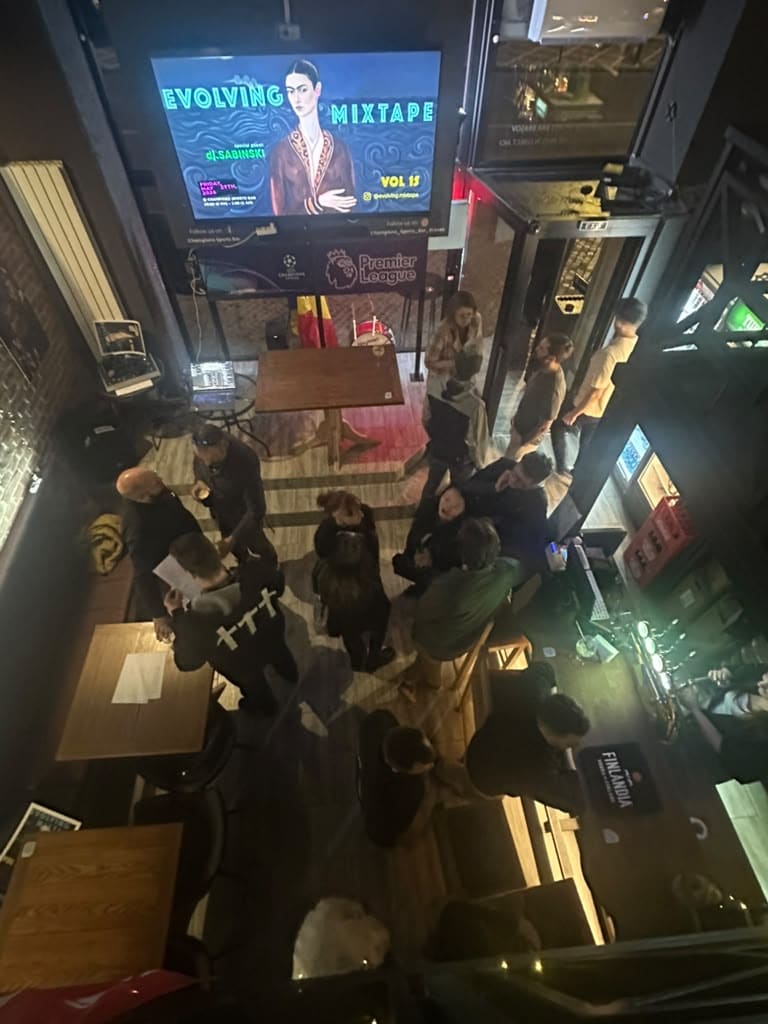
EMT a fost primul eveniment public non-sportiv găzduit de Champions, un risc asumat de Lawrence care a dat roade. Inspirația lui David a venit parțial dintr-un loc numit „The Pink” din Buffalo, New York — un bar întunecat, aglomerat, unde muzica excepțională crea o vibrație unică. Aceeași intimitate a fost recreată la Brașov. Contrastul este deliciul criticului cultural: pe ecranele unde de obicei rulează meciuri de fotbal, organizatorii au început să ruleze filme de David Lynch sau anime-uri pe mut, în timp ce playlist-ul serii crea o coloană sonoră accidentală și suprarealistă.
„Am privit tot filmul lui Lynch cu această muzică care nu a fost scrisă pentru el și a fost incredibil”, povestea unul dintre participanții EMT.
Această sinergie între vizualul mut și sonorul experimental transformă barul într-un hub cultural fluid. Nu este un mediu steril de club; este un spațiu unde oamenii stau în picioare, se amestecă, ies la țigară discutând despre post-punk și revin atrași de un riff de metal. Este susținerea reciprocă dintre un business local și o subcultură care refuză să fie invizibilă.
Vizualul DIY: De la Microsoft Word la estetica de colecție
Evoluția identității vizuale a Evolving Mixtape oglindește creșterea organică a proiectului. În primele zile, David crea afișele în Microsoft Word, un gest pur DIY, lipsit de pretenții artistice, dar încărcat de onestitatea comunicării directe. Odată cu implicarea lui Matei, un prieten de-al lui Vlad și designer grafic, afișele au început să capete o dimensiune de „artă de colecție”.
Matei a abordat fiecare poster ca pe o „copertă de album” a evenimentului, oferind mișcării un prestigiu vizual care depășește granițele unui simplu anunț de bar. Dar adevărata forță a promovării a rămas cea fizică. David, Philip și Vlad petreceau ore în șir străbătând străzile Brașovului pe jos, lipind afișe fizice în geamurile afacerilor prietene sau pe ziduri. Această metodă „învechită” a atras oameni care se află în afara radarului social media, cum a fost cazul unei persoane, care a venit la eveniment doar pentru că a văzut un poster pe stradă.
Aceste afișe nu sunt doar unelte de marketing; ele funcționează ca o arhivă culturală a orașului. Ele marchează teritoriul, transformând Brașovul dintr-un oraș turistic static într-o scenă vie, unde arta grafică și muzica underground colaborează pentru a crea o identitate urbană nouă. Posterul pe ecranul barului, orientat spre stradă, a devenit semnalul că „ceva se întâmplă”, o ancoră vizuală care spune trecătorului: „aici ești liber să fii curios”.


„San Francisco feeling” în inima Transilvaniei
Poate cel mai remarcabil aspect al EMT este capacitatea sa de a fi un „teren neutru” pentru coexistare. Într-o societate tot mai polarizată, acest eveniment a reușit să adune sub același acoperiș adolescenți, studenți, intelectuali de vârstă mijlocie și seniori de peste 70 de ani. Muzica devine numitorul comun care dizolvă barierele politice sau generaționale.
Un punct de cotitură a fost colaborarea pentru evenimentul Pride Brașov. Transformarea unui bar de sporturi într-un sanctuar al diversității LGBTQ+ a fost o declarație de solidaritate profundă. Philip își amintește de „vibe-ul” acelei seri:
„A fost un sentiment de San Francisco… nu se simțea ca în Brașov. Am creat un spațiu unde oamenii se pot simți confortabil și se pot exprima liber.”
Această incluziune nu este una performativă sau forțată; este rezultatul firesc al unei filosofii care respectă demnitatea umană și libertatea de exprimare. Într-un loc unde poți vorbi despre jazz experimental sau despre mișcări artistice fără teama de a fi judecat, barierele sociale se topesc. EMT a devenit o dovadă că muzica poate acționa ca un liant social mult mai eficient decât orice discurs politic, oferind un spațiu unde diversitatea este trăită, nu doar proclamată.
„Make Your Own Culture”: Manifestul care nu mai așteaptă permisiunea
Evolving Mixtape nu este doar despre muzică; este despre refuzul de a fi un consumator pasiv. Filosofia „Make Your Own Culture”, moștenită din spiritul punk și indie al anilor ’80-’90, este mesajul cel mai puternic pe care David, Philip și Vlad îl transmit. Dacă nu găsești în orașul tău scena culturală care să te reprezinte, nu te plânge, construiește-o singur.
Proiectul a început să funcționeze ca o „franciză a entuziasmului”. Un cercetător german care a participat la eveniment a fost atât de impresionat încât a decis să ducă conceptul în Germania. David, întors acum în Buffalo, se gândește să pornească „Evolving Mixtape Buffalo”. Nu există copyright pe această idee, nu există dorință de profit. Există doar dorința de a vedea acest „model de comunitate” replicat oriunde există oameni dornici să scape de izolarea digitală.
În final, EMT este o rețetă simplă pentru vindecarea urbană: ai nevoie de un playlist de 45 de minute, de un bar care să accepte riscul și de curajul de a lăsa mainstream-ul la ușă. Este invitația de a redeveni „animale sociale”, de a descoperi un prieten nou în timp ce asculți un grup de hip-hop underground sau de a înțelege că, dincolo de algoritmi, există o lume vibrantă, imprevizibilă și profund umană care așteaptă să fie ascultată. Brașovul a demonstrat că revoluția DIY nu are nevoie de bugete uriașe, ci de oameni care au ceva de spus și de un loc unde să fie lăsați să o spună. Make your own culture nu e doar un slogan; e singura cale de a rămâne umani într-o lume automatizată.
În final, vă las link la un material publicat chiar de David Gracon, în care detaliază propria perspectivă asupra Evolving Mixtape, din poziția de inițiator.
[EN]
M | Evolving Mixtape: DIY in the Brașov Music Community
I discovered Evolving Mixtape in 2025, when I accepted an invitation from a friend to grab a beer at Champions Sports Bar. The evening felt different because the bar hadn’t announced anything about what was about to happen. That’s when I learned more about Evolving Mixtape and how to contribute a playlist.
I never thought I’d do this, but after a second Evolving Mixtape night, I decided to contribute a personal playlist, which I named Meowsic.
About a year after creating that playlist and attending the Evolving Mixtape event, I had the pleasure of chatting with David, Philip, and Vlad about Evolving Mixtape—how the idea came about, how it works, and the whole significance behind the DIY (Do It Yourself) concept.
We live in an era that contemporary sociologists increasingly define through the lens of an “epidemic of loneliness.” Although we’re interconnected by thousands of invisible digital threads, the paradox is that our isolation within algorithmic bubbles has never been deeper. We feed on automated suggestions, playlists that confirm our musical biases, and screen-mediated interactions that sterilize the human experience. In this landscape of urban alienation, a seemingly trivial question takes on the weight of a manifesto: how did a sports bar in Brașov manage to become the epicenter of a cultural resistance movement, where extreme metal, avant-garde jazz, and Turkish music come together and build, track by track, the idea of community?
The answer lies in the name Evolving Mixtape (EMT). It’s not just another listening night, but a social and musical experiment born from the desire to reclaim public space from the dictatorship of predictability. Initiated by David, a professor who came to Romania through the Fulbright program, together with Philip and Vlad, the project transformed Champions Sports Bar from a venue for sports scores into a laboratory for participatory curation. It’s a story about authenticity, the DIY spirit, and the courage to say “no” to the mainstream—all sparked by a conversation among friends who believed that music deserves more than just a shuffle button.
Democratizing Music Through Participation
Traditionally, DJ culture has been shrouded in an aura of exclusivity. The barriers are, more often than not, technical and financial: you need expensive vinyl records, high-performance turntables, and technical dexterity acquired through years of practice. David, whose vision was shaped by the vibrant “free-form” college radio scene in Oregon, USA, realized that this model, while valuable, often functions as a cultural “gatekeeper.” The DJ is the one who possesses the knowledge, while the audience is merely a passive recipient.
From its very first edition three years ago, the philosophy behind Evolving Mixtape has been to tear down these walls. David wanted to bring the spirit of independent radio into a community space, eliminating elitism. Here, the “booth” is not a protected space, but an open invitation.
This democratization meant that anyone – from a student with a USB drive to a curious passerby – could become a curator for 45 minutes. A defining moment was that of Misha, a young man from the Republic of Moldova, who simply showed up off the street with a bag of vinyl records under his arm. In any other club, he would have been politely turned away; at EMT, he was immediately offered the space to share his sonic universe. The result? An evening that stretched into the early morning, turning into a celebration of spontaneity. This “controlled sonic anarchy” shifts the focus from technical performance to emotional selection, transforming the act of playing music into a form of human dialogue.
The 45-Minute Rule: The Art of Storytelling Through Emotional Constraints
The central element that gives structure to the creative chaos at EMT is the 45-minute limit for each playlist. Although it seems like a logistical decision, the root of this rule is deeply nostalgic and symbolic: it is the exact duration of one side of an audio cassette. In the ’90s, making a “mixtape” for a friend or a girlfriend was an act of intention; you had to think through the flow, match the song lengths, and build a narrative that would fit perfectly on the magnetic tape.
This limitation forces the playlist creator to step outside the comfort zone of infinite consumption. On Spotify, you can throw 200 songs into a playlist without batting an eye. At EMT, the 45-minute limit forces you to “curate the essence”. Vlad describes this timeframe as the ideal “sweet spot”: long enough to build a story or an atmosphere, but short enough to maintain the evening’s energy and allow as many voices as possible to be heard.
From a sociological perspective, this rule prevents the event from becoming a platform for musical subjectivity. When someone brings a three-hour playlist, they are abusively taking up the community’s space. The 45-minute limit is, paradoxically, a form of collective freedom. It forces the person proposing the music to ask themselves: “What is truly important to me right now?” In this way, the playlist ceases to be a mere succession of songs and becomes a musical “short film,” a personal confession that respects the time and attention of others.
Human Error as a Cultural Value
Streaming algorithms are designed to give us “more of what we already like,” creating echo chambers that stifle our curiosity. Evolving Mixtape is, at its core, an act of digital sabotage. Here, the only strict rule is “no mainstream”. You won’t hear radio hits or songs you can hear in any café in Europe or North America.
There is the “Deep Cut exception”: if you absolutely want to play a track by a major artist, such as Alice in Chains or even Madonna, you have to seek out that obscure track, that forgotten remix, or that rare recording that has never been “eroded” by mass consumption. This approach transforms the listener into an explorer.
The sonic diversity is dizzying and, at times, downright intense in its eclecticism. In a single evening, the landscape can change radically: from the death metal of Dying Fetus (a discovery that left such a mark on David that he later went to see them in concert in Buffalo) to the atmospheric post-metal of Deafheaven, passing through the hardcore of the Brașov-based band I Stared Into the Forest. Vlad brought up sounds from Iran and Turkey that left the audience speechless, proving that underground music knows no borders. This “education through surprise” forces us to embrace the unknown, offering us something an algorithm will never be able to provide: the experience of discovery through another person’s mistakes and passion.
When “Champions” Becomes a Cultural Space
The choice of location, the “Champions” bar, is a lesson in organic cultural urbanism. A sports bar, by definition, is a functional space focused on screens broadcasting competitions and on quick consumption. However, under the leadership of Lawrence – a bold owner who understood that an independent business survives through community, not just through transactions—the bar has been transformed.
EMT was the first non-sports public event hosted by Champions, a risk Lawrence took that paid off. David’s inspiration came partly from a place called “The Pink” in Buffalo, New York – a dark, crowded bar where exceptional music created a unique vibe. That same intimacy was recreated in Brașov. The contrast is a cultural critic’s delight: on the screens that usually show soccer matches, the organizers began playing David Lynch films or anime on mute, while the evening’s playlist created an accidental and surreal soundtrack.
“I watched Lynch’s entire film with this music that wasn’t written for it, and it was incredible”, recounted by one of the EMT participants.
This synergy between the silent visuals and the experimental sound transforms the bar into a fluid cultural hub. It’s not a sterile club environment; it’s a space where people stand around, mingle, step outside for a cigarette while discussing post-punk, and come back drawn by a metal riff. It’s the mutual support between a local business and a subculture that refuses to be invisible.
The DIY Visual Style: From Microsoft Word to Collectible Art
The evolution of Evolving Mixtape’s visual identity mirrors the project’s organic growth. In the early days, David created the posters in Microsoft Word – a purely DIY approach, devoid of artistic pretensions but imbued with the honesty of direct communication. With the involvement of Matei, a friend of Vlad’s and a graphic designer, the posters began to take on the quality of “collectible art”.
Matei approached each poster as an “album cover” for the event, giving the movement a visual prestige that transcends the boundaries of a simple bar announcement. But the real power of the promotion remained its physical presence. David, Philip, and Vlad spent hours on end walking the streets of Brașov, putting up posters in the windows of friendly businesses or on walls. This “old-fashioned” method attracted people who are off the social media radar, as was the case with one person who came to the event simply because they saw a poster on the street.
These posters aren’t just marketing tools; they function as a cultural archive of the city. They mark the territory, transforming Brașov from a static tourist town into a living stage, where graphic art and underground music collaborate to create a new urban identity. The poster on the bar’s screen, facing the street, has become the signal that “something is happening” – a visual anchor that tells passersby, “here, you’re free to be curious”.
“San Francisco Feeling” in the Heart of Transylvania
Perhaps the most remarkable aspect of EMT is its ability to serve as “neutral ground” for coexistence. In an increasingly polarized society, this event has managed to bring together under one roof teenagers, college students, middle-aged intellectuals, and seniors over 70. Music becomes the common ground that breaks down political and generational barriers.
A turning point was the collaboration for the Pride Brașov event. Transforming a sports bar into a sanctuary of LGBTQ+ diversity was a profound statement of solidarity. Philip recalls the “vibe” of that evening:
“It felt like San Francisco… it didn’t feel like Brașov. We created a space where people can feel comfortable and express themselves freely.”
This inclusion isn’t performative or forced; it’s the natural result of a philosophy that respects human dignity and freedom of expression. In a place where you can talk about experimental jazz or artistic movements without fear of being judged, social barriers melt away. EMT has become proof that music can act as a social glue far more effectively than any political discourse, offering a space where diversity is lived, not just proclaimed.
“Make Your Own Culture”: The Manifesto That No Longer Waits for Permission
Evolving Mixtape isn’t just about music; it’s about refusing to be a passive consumer. The “Make Your Own Culture” philosophy, rooted in the punk and indie spirit of the ’80s and ’90s, is the most powerful message that David, Philip, and Vlad convey. If you can’t find a cultural scene in your city that represents you, don’t complain – build it yourself.
The project began to function as a “franchise of enthusiasm”. A German researcher who attended the event was so impressed that he decided to bring the concept to Germany. David, now back in Buffalo, is thinking of launching “Evolving Mixtape Buffalo”. There’s no copyright on this idea, no desire for profit. There is only the desire to see this “community model” replicated wherever there are people eager to escape digital isolation.
Ultimately, EMT is a simple recipe for urban healing: you need a 45-minute playlist, a bar willing to take a risk, and the courage to leave the mainstream at the door. It’s an invitation to become “social animals” again, to discover a new friend while listening to an underground hip-hop group, or to realize that, beyond algorithms, there’s a vibrant, unpredictable, and deeply human world waiting to be heard. Brașov has proven that the DIY revolution doesn’t need huge budgets, but rather people who have something to say and a place where they’re allowed to say it. “Make your own culture” isn’t just a slogan; it’s the only way to remain human in an automated world.
Finally, here’s a link to an article published by David Gracon himself, in which he details his own perspective on Evolving Mixtape from the standpoint of the founder.
Foto/images credit to Evolving Mixtape
Leave a Reply